



Facing Fear — The Real Kind
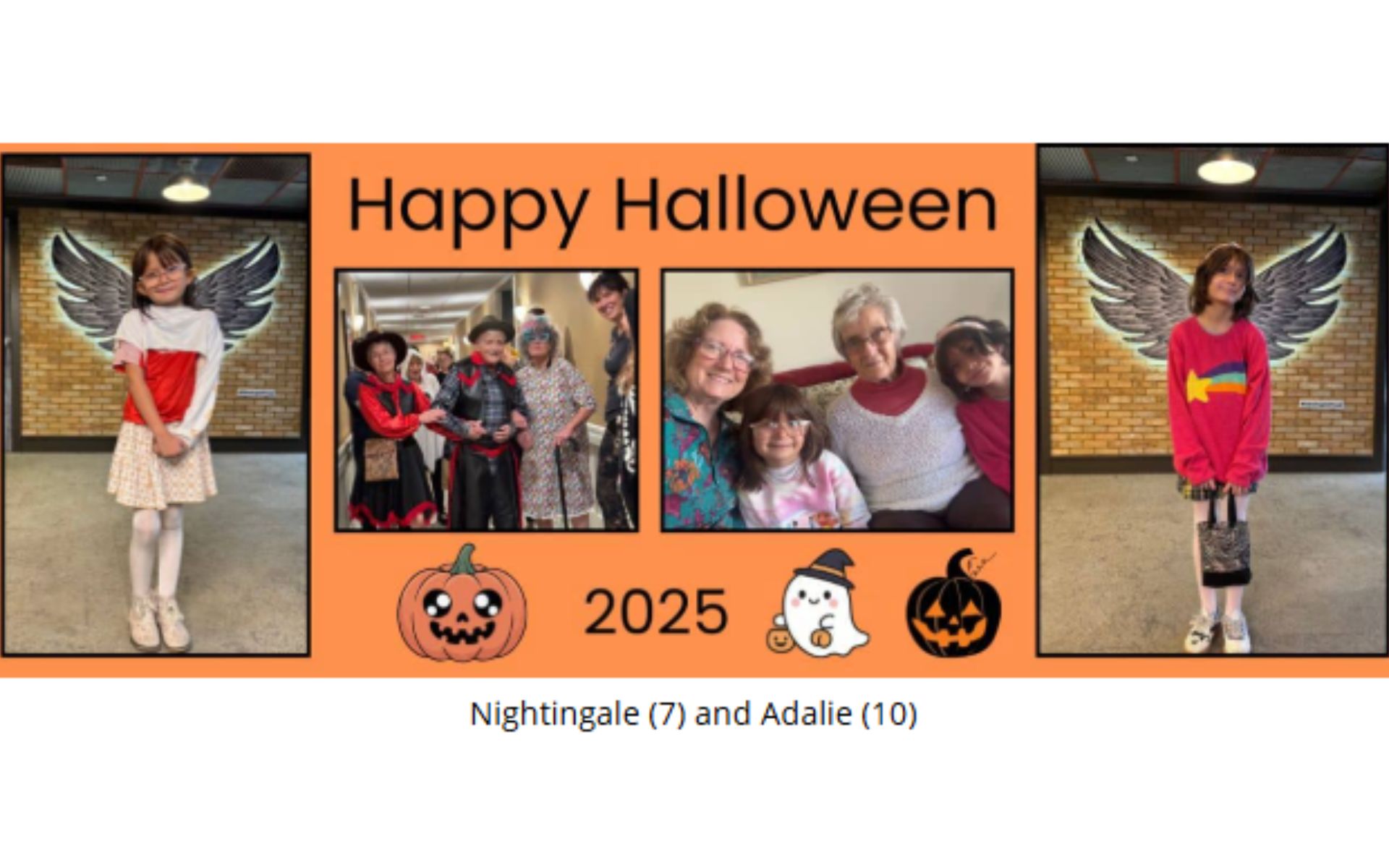
This past weekend, I took 2 of my grandchildren, Nightingale and Adalie, to my mom’s senior community at Elim Park for a costume parade and trick-or-treating.
We had a lot of fun.
The halls were filled with the residents’ great-grandchildren and the staff’s kids, in costume with their candy buckets.
Many of the residents were there as well—some in funny hats, others in full-blown costumes.
I saw fairies, ghosts, witches, sock-hop dancers, a geisha, and a nun and a monk in the crowd.
The residents lit up as the little ones paraded by, each child wearing some version of courage on their sleeve.
For example, there was one cute kid who had a prickly cactus suit on, with a sign across his chest that said “FREE HUGS!”
And those elders weren’t afraid to ask for hugs either!
I heard his mom say at one point, “Oh I bet he’s gonna regret choosing that costume.” After I laughed she explained that he was a real shy kid. It was courageous that he was giving hugs to strangers.
I love seeing the generations come together like that.
The children get to show off, the elders get to relive their own memories, and in between, there is this beautiful energy of playfulness—and of course . . . candy.
Halloween is an opportunity to explore scary things when you’re a kid, and we make it fun. But as adults, our fears take on a different form.
The Many Faces of Fear
I’m learning a lot about fear and the brain in my Hypnotherapy course.
Psychologically, fear is a survival response — our body’s alarm system. It warns us of danger, helps us stay alive, and keeps us cautious.
These are the different types of fear, and they are each very different.
- Physical fear keeps us from stepping into traffic or touching a hot stove.
- Social fear keeps us worried about rejection, embarrassment, or disapproval.
- Emotional fear shows up when we’re afraid to love again, to speak our truth, or to try something new.
- Existential fear lurks deeper — the fear of failure, change, or even success.
When we spend too much time in these states, fear can become a habit — a default setting that prevents us from evolving.
We can easily convince ourselves it’s safer to stay still, even if “still” means stuck.
Overcoming Fear — One Step at a Time
Here are a few ways to loosen the grip of fear:
- Name it. You can’t change what you won’t acknowledge. Saying, “I’m afraid of rejection” or “I’m scared to fail” begins to disarm it.
- Breathe through it. Fear often lives in the body — tight chest, shallow breathing, racing thoughts. Slow, deep breaths signal your brain that you’re safe.
- Reframe the story in your head. Instead of “I hate change,” try “I’m curious about what this change might bring.” Curiosity dissolves fear.
- Take micro-actions. Courage grows with repetition. Each time you take one small step outside your comfort zone, your confidence expands.
- Look for meaning. Ask, “What will I gain from overcoming this fear?” When your purpose is clear, fear loses its authority.
Living Life Beyond Fear
When we let fears dominate us, our world shrinks.
But when we face it, with self-compassion, patience, and faith, our world gets bigger. We become more creative, more authentic, and more alive.
This feels like freedom to me.
Just like kids finding the courage to go into a haunted house, we can learn to wear our courage proudly, too.
We can show up for life and face our fears by wearing a costume-of-confidence. Act as if, and the feeling will follow.
Maybe fear never disappears entirely, but we can learn to walk with it rather than run from it.
This includes stepping into the next best version of yourself as a leader, a parent, a friend, a speaker, or any other role you want to take on.
So this Halloween, as the ghosts and goblins come out, take a moment to ask yourself:
What am I afraid of that isn’t actually out to harm me?
Then keep taking baby steps forward, shine your light in the darkness, and keep going.
And remember, there are Divine angels you can call on, and earthly angels are among us too. You are not alone.
Many blessings during the scary season and the darkest time of the year.
Keep the faith and stay strong,
Love,
Maureen
P.S. In case you didn’t know . . .
A Brief History of Halloween
Halloween actually began more than 2,000 years ago with the ancient Celtic festival of Samhain (pronounced sow-in).
It marked the end of harvest and the beginning of winter — the “darker half” of the year.
People believed that on October 31, the veil between the living and the dead grew thin, and spirits could walk among us. To protect themselves, they wore costumes and lit bonfires — not for fun, but for safety.
Over time, this tradition blended with Christian observances of All Saints’ Day and All Souls’ Day, becoming what we now call Halloween.