


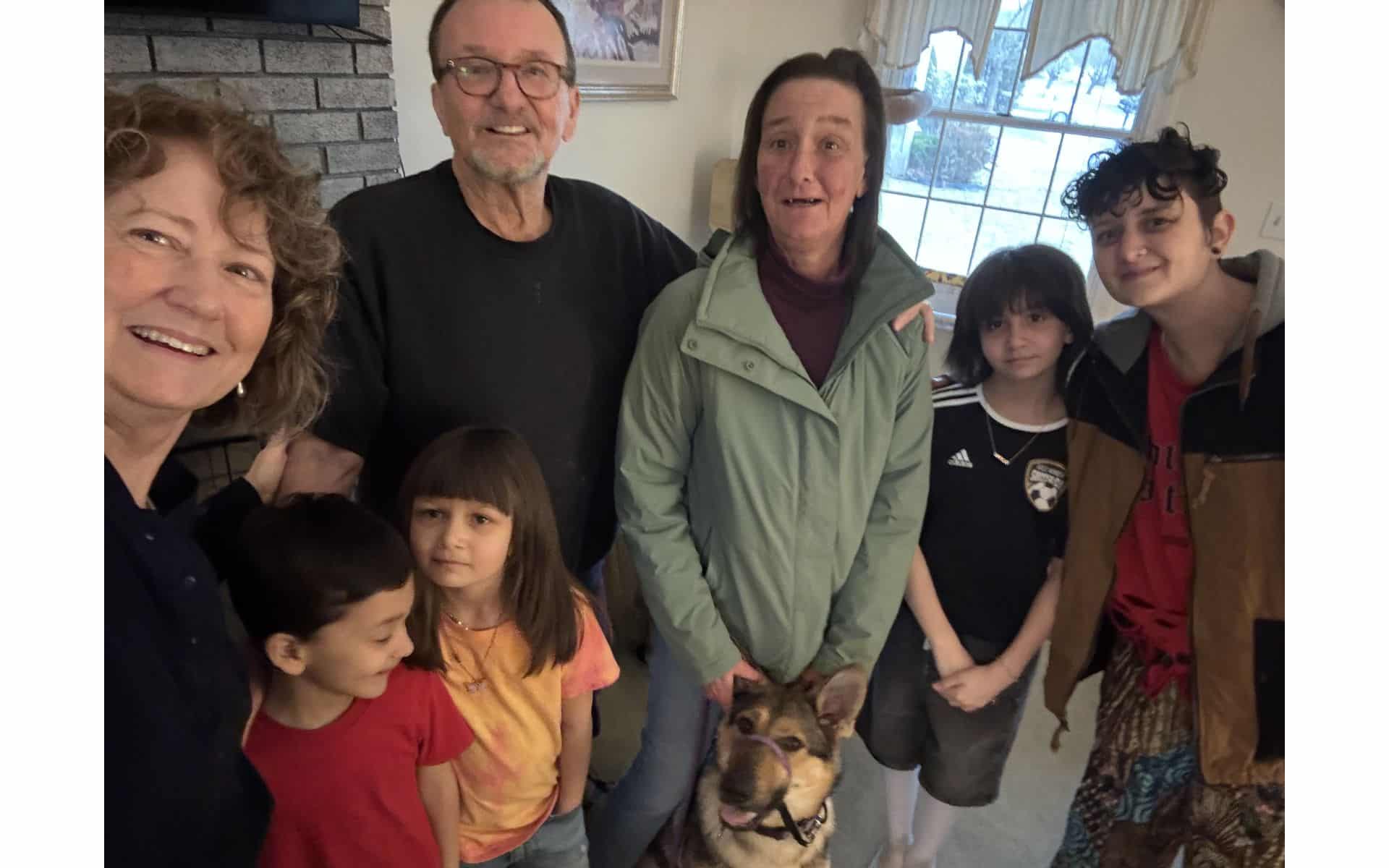
This weekend, our home was lively and full of energy because we invited 3 of the grandkids for a sleepover.
There was that kind of joyful chaos that fills a house with life. There was a dance party in the new basement with blankets and pillows everywhere. We bought cookies, ice cream, and had pancakes for breakfast. Things I haven’t eaten for quite a while, and it took me 3 days to get it out of my system. LOL!
But I want to tell you about a special experience. On Sunday morning, Paul’s daughter Jessie arrived with a very special guest.
You see Jessie is fostering a beautiful 9-month-old German Shepard dog named Grace through Fidelco, an organization that trains dogs to become seeing-eye companions. Jessie has done this for them many times. She worked there for quite a few years.
What this means is that for 18 months, Grace will be trained how to support someone who cannot see. She’ll learn to stay focused, calm, and responsive in a busy, unpredictable world, so she can eventually be a support companion for a disabled person.
Before bringing Grace into the room, Jessie gathered the kids and explained what fostering means. Then she gave each of them a small treat so the dog would associate them with safety and friendliness.
It was training for everyone.
Grace had never been around young children before.
She was excited, playful, curious — very much a puppy.
The children were thrilled and wanted to engage her constantly.
After about twenty minutes, Jessie placed a vest on Grace. It was her “support dog vest.”
Within moments, the dog’s behavior changed.
She calmed down. Her body became still.
Her attention shifted. She lay calmly at Jessie’s feet, no longer interacting with the children.
The vest had become a cue — a signal to her brain that it was time to work.
The children also had to learn a new response.
They were coached to resist calling her or touching her.
Everyone in the room was practicing new behavior patterns.
How we learn. How we change habits.
Watching this unfold, I was reminded how both animals and humans learn — and how difficult change can feel as we grow older.
Many of us try to change habits using determination, logic, or motivation.
We make plans. We set goals. We promise ourselves we will “do better.”
Yet despite our best intentions, we often return to familiar behaviors.
There is a neurological reason for this.
The conscious mind — the part that makes decisions and sets intentions — is only a small portion of our mental processing. You might think of it as the tip of an iceberg.
Beneath the surface lies the subconscious mind.
This is where habits, emotional responses, beliefs, and protective patterns are stored. These patterns are shaped over years through repetition and experience. They operate automatically, often outside of awareness.
The unconscious mind is even deeper than that which I’ll discuss another time.
Back to the subconscious – from a brain perspective, well-established neural pathways require less energy to activate. The nervous system naturally chooses what is familiar and efficient, even when those patterns no longer serve us.
This is why change can feel so hard.
Hypnotherapy works by helping a person enter a focused, relaxed state sometimes called a trance. In this state, activity in the analytical, critical part of the mind softens and goes to sleep or focuses on something boring (like breathing). The “gatekeeper” of the subconscious then becomes less guarded.
This allows me, the hypnotherapist, to insert new ideas, imagery, and emotional associations to be experienced more directly. The brain can begin to rehearse different responses. Sometimes instantly, or sometimes over time, new neural pathways will take over and strengthen while older patterns gradually or instantly lose power and fall away.
Rather than forcing change through conscious effort alone, hypnotherapy supports the brain and nervous system in learning a new internal program that aligns with what you want and desire in your life.
Just as Grace is being trained to respond differently to the world around her when she has the vest on, we too can learn new ways of thinking, feeling, and behaving — even later in life.
Reflection for this week
Where might you be trying to create change through willpower… when what you really need is deeper subconscious retraining?
Stay tuned for next week’s newsletter, where I will discuss stress — how it affects us mentally and physically — and why calming the nervous system is essential for making lasting changes and experiencing transformation.
I will also be opening my schedule to a limited number of readers for complimentary stress-relieving hypnotherapy sessions.
In the meantime, let’s welcome spring to the Northeast. (That’s really a prayer right there!)
Warmly,
Maureen